


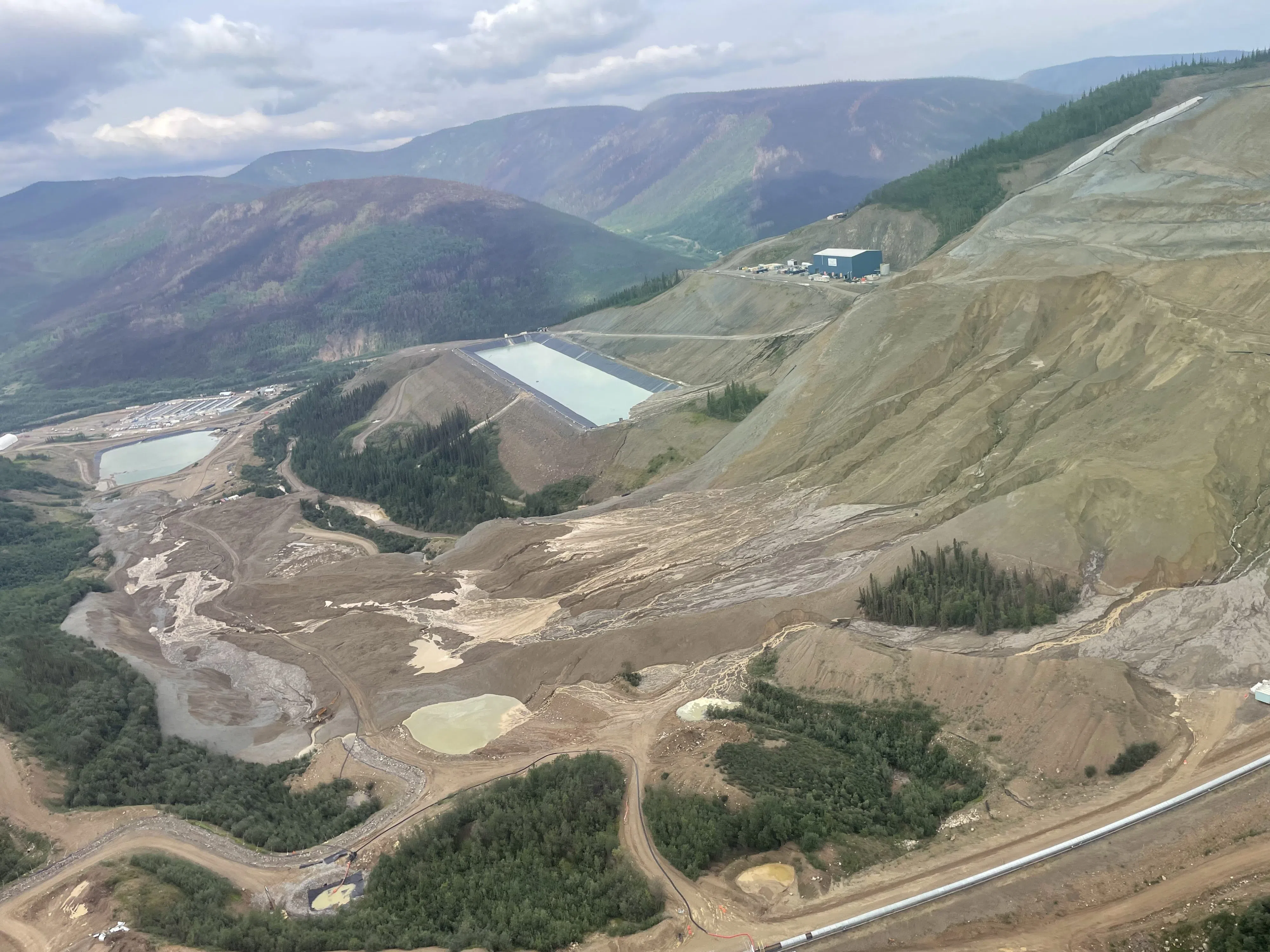
An arial view of the aftermath of a landslide at the heap leach facility at the Eagle Gold Mine. Photo Courtesy of Yukon Government.
Whitehorse, YT – Yukon’s 3.3 per cent drop in real GDP last year may not reflect the territory’s broader economy, says a senior government economist, who points to the shutdown of the Eagle Gold Mine as the main driver.
Preliminary data from Statistics Canada shows mining activity fell nearly 32 per cent in 2024. Kailer Mullet, the Yukon government’s director of economic research, said the mine showed revenue of $416.9 million in 2023 — roughly 10 per cent of the territory’s GDP that year.
Mullet said the mine’s shutdown accounted for much of the decline in 2024.
“That’s taking about three percentage points off that real GDP number, just from the Eagle Gold [Mine],” said Mullet. “Without that we’d be talking about two percent.”
GDP also shows a 12.4 per cent drop in construction, despite earlier signs of growth. Mullet said the data may not yet reflect remediation or infrastructure projects not captured by building permit figures.
He noted real GDP is often revised by about 1.3 percentage points once tax data is added and warned against using GDP alone to assess Yukon’s economy.
“Those mining numbers really do throw around our GDP in a way that you have to be very careful when inferring from what GDP did into what’s going on in the actual economy,” said Mullet.
The Liberal government points to low unemployment and strength in tourism and public services as signs of economic resilience.
Opposition Leader Currie Dixon calls the decline “worrying” and accuses the government of denying reality. The Yukon Party is calling for less red tape, faster permitting, and more support for local agriculture and forestry.


